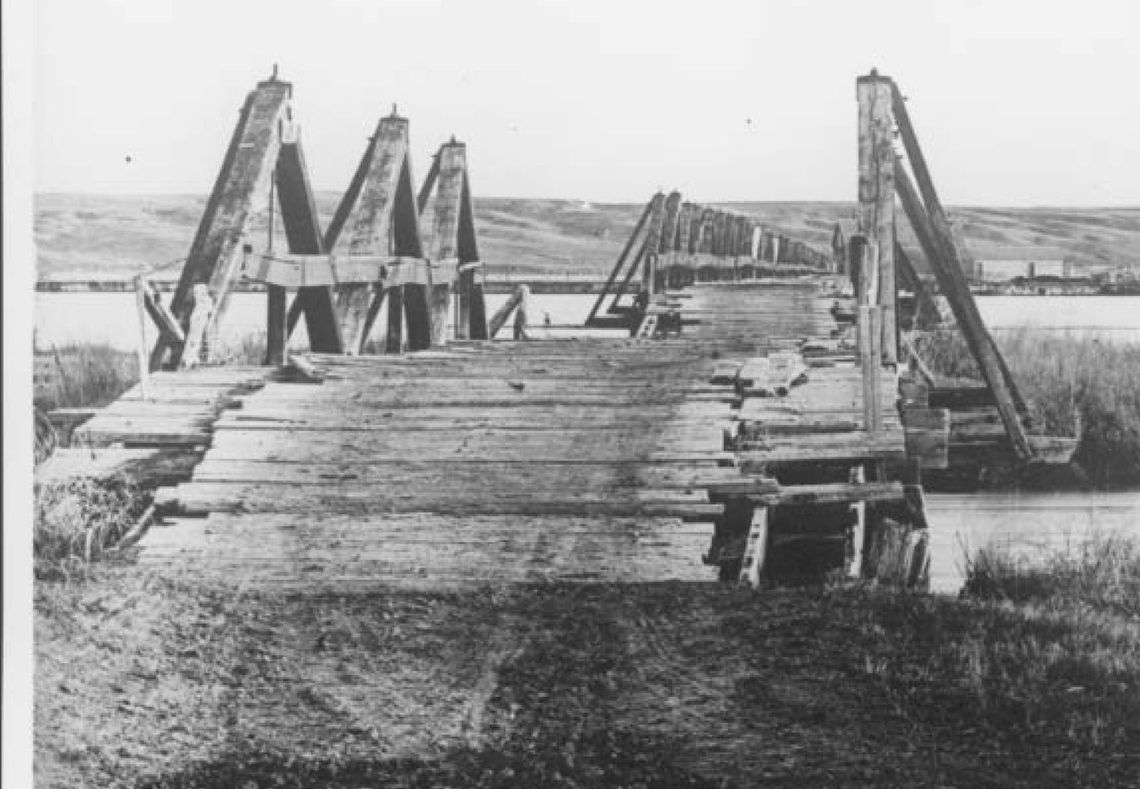
In the winter of 1875, Omaha jobbers contacted Henry T. Clarke, a veteran Nebraska freighter and bridge builder, to construct a short line between Sidney and the military stations and the Black Hills gold country. Because of lack of eastern investor interest, a toll bridge was constructed by his bridge foreman and local volunteers.
The Chicago & Rock Island and the Union Pacific railroads saw the importance of the move, and freighted all material free of cost from the lumber yard of Katers & Son, Moline, Ill., and Schruker & Miller, Davenport, Ia., to Sidney—consisting of three large wagon train loads—and teamed from Sidney to the river. The iron was manufactured in Milwaukee, and piles were secured in the hills southwest of the bridge site.
This toll bridge opened in May, 1876 and was one of the strongest and best of the Platte River bridges. In addition to providing passage to the military outposts, it was strong enough to carry mining machinery, on short, coupled wagons, drawn by seven to ten yokes of cattle, and, in fact, strong enough to carry a railway train. Stage lines, Great Western Cattle drives, and even local residents were also among those paying the toll to use the bridge thus paying the construction cost within what is said to be the first month that the bridge was open.